
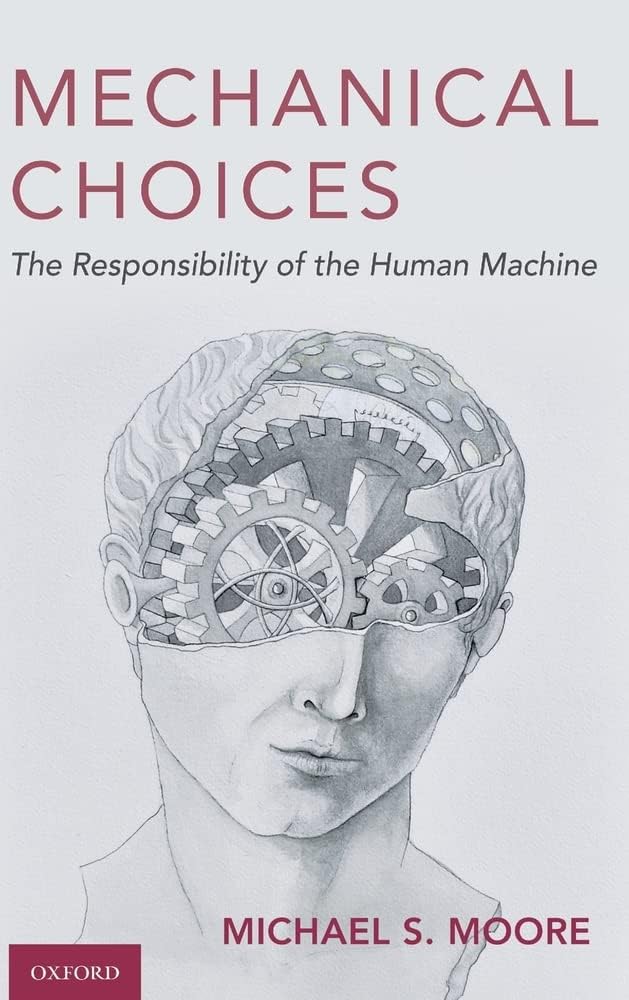
Description
Book Synopsis: Mechanical Choices details the intimate connection that exists between morality and law: the morality we use to blame others for their misdeeds and the criminal law that punishes them for these misdeeds. This book shows how both law and morality presuppose the accuracy of common sense, a centuries-old psychology that defines people as rational agents who make honorable choices and act for just reasons. It then shows how neuroscience is commonly taken to challenge these fundamental psychological assumptions. Such challenges--four in number--are distinguished from each other by the different neuroscientific facts from which they arise: the fact that human choices are caused by brain events; the fact that those choices don't cause the actions that are their objects but are only epiphenomenal to those choices; the fact that those choices are identical to certain physical events in the brain; and the fact that human subjects are quite fallible in their knowledge of what they are doing and why. The body of this book shows how such challenges are either based on faulty facts or misconceived as to the relevance of such facts to responsibility. The book ends with a detailed examination of the neuroscience of addiction, an examination which illustrates how neuroscience can help rather than challenge both law and morality in their quest to accurately define excuses from responsibility.
Details
Looking to explore the intricate connection between morality and law? Introducing Mechanical Choices: The Responsibility of the Human Machine. Delve into the depths of this captivating book and unlock the secrets that lie within the bond between our moral judgments and the criminal justice system. Discover how common sense, deeply rooted in human psychology, plays a pivotal role in shaping our perception of rational agents who make honorable choices based on just reasons.
Prepare to be enlightened! Some claim that neuroscience challenges these fundamental psychological assumptions. However, in Mechanical Choices, we debunk these challenges, presenting four distinct ones that emerge from various neuroscientific facts. Learn how these challenges, stemming from notions like brain events causing human choices and choices being epiphenomenal to actions, fail to undermine the psychological basis of responsibility. Gain a thorough understanding of how fallibility in knowledge and the identity of choices with specific physical events in the brain do not diminish the core principles of morality and law.
But the journey doesn't end there. In the final chapters, Mechanical Choices delves deep into the neuroscience of addiction, demonstrating how this field can remarkably contribute to the fair definition of excuses from responsibility. Witness firsthand how neuroscience can be an ally, rather than a foe, in our continuous pursuit of accurately understanding and defining the boundaries of law and morality.
Uncover the gripping truth behind the relationship between morality, law, and the human mind with Mechanical Choices: The Responsibility of the Human Machine. Start your exploration today for a thought-provoking and enlightening experience! Get your copy now
Discover More Best Sellers in Law
Shop Law

 Law - The Anthropology of Islamic Law: Education, Ethics, and Legal Interpretation at Egypt's Al-Azhar (Oxford Islamic Legal Studies)


The Charter of the United Nations: A Commentary (Oxford Commentaries on International Law)
 Law - The Charter of the United Nations: A Commentary (Oxford Commentaries on International Law)



 Law - The Customs of Catalonia Between Lords and Vassals: By the Barcelona Canon, Pere Albert : A Practical Guide to Castle Feudalism in Medieval Spain (Medieval & Renaissance Texts & Studies)

 Law - 1l of a Ride: A Well-traveled Professor's Roadmap to Success in the First Year of Law School (Academic and Career Success Series)


